Google Ads and Meta Ads (Facebook and Instagram) are the two platforms most Indian businesses consider first when starting with paid advertising. They work in fundamentally different ways, and picking the right one to start with, or the right mix, depends on your business and goal. This article breaks down the core differences.
How the two platforms fundamentally differ
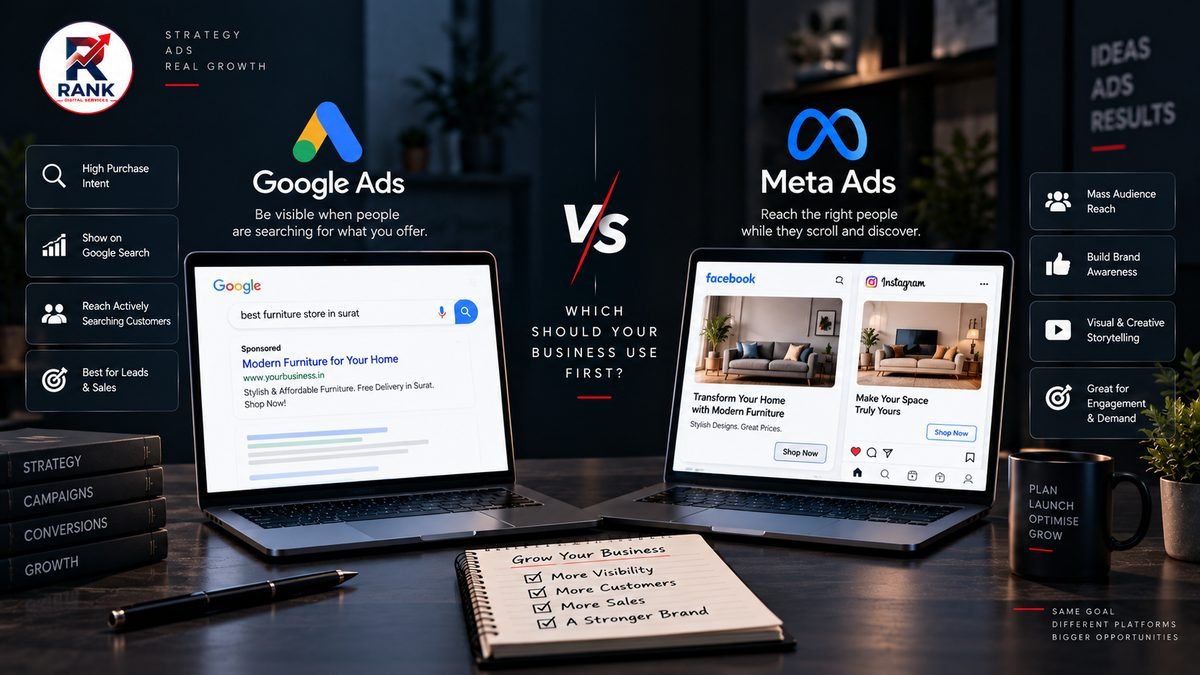
Google Ads is largely built around intent. Search ads appear when someone actively searches for something related to your product or service, meaning they're often already looking for a solution. Meta Ads is largely built around interruption and interest, ads appear in someone's feed based on their demographics, interests and behaviour, whether or not they were actively looking for what you offer at that moment.
Neither approach is inherently better. They serve different stages of a customer's decision process.
When Google Ads tends to work well
- Your product or service is something people actively search for (e.g. "AC repair near me," "CA for GST filing," "buy office chairs online").
- You want to capture demand that already exists, rather than create awareness from scratch.
- Your business has a clear, specific offer that matches how people phrase their searches.
Search intent tends to convert relatively well because the person is already looking for a solution, your job is largely to be visible and relevant when they search.
When Meta Ads tends to work well
- Your product is more discovery-driven, people don't necessarily search for it by name (fashion, home decor, unique products, new services).
- You have strong visual assets, photos or video that show your product or service clearly.
- You want to build broader brand awareness, not only capture immediate intent.
- You want to retarget people who've already visited your website or engaged with your content.
Meta Ads often plays a role earlier in the customer journey, introducing your business to people who didn't know they needed you yet.
Cost and competition considerations
Google Ads costs are heavily influenced by keyword competition, highly competitive terms in categories like insurance, finance or legal services can be expensive per click. Meta Ads costs are influenced more by audience size, targeting specificity and how well your creative performs (ads people actually engage with tend to cost less to run). Neither platform has a fixed, predictable cost across industries, it's worth testing with a modest budget before committing heavily.
Tracking and measurement
Both platforms rely on proper conversion tracking to tell you whether ad spend is actually producing results, form submissions, calls, purchases. Without this set up correctly, it's very difficult to judge whether a campaign is actually working, regardless of which platform you use. This is one of the most commonly skipped steps, and one of the most important.
A side-by-side comparison
| Factor | Google Ads | Meta Ads |
|---|---|---|
| Primary strength | Capturing existing search intent | Building awareness and discovery |
| Best suited for | Searched-for products and services | Visual, discovery-driven products |
| Typical cost driver | Keyword competition | Audience size and creative performance |
| Targeting basis | Search keywords and intent | Demographics, interests, behaviour |
Do you have to choose only one?
Not necessarily. Many businesses eventually run both, Google Ads to capture people actively searching, and Meta Ads to build broader awareness and retarget website visitors who didn't convert on their first visit. If budget is limited, it's usually more effective to start with one platform, get conversion tracking right, and expand once you understand what's working, rather than splitting a small budget too thin across both from day one.
Choosing where to start
A practical way to decide: if your customers are already searching for what you offer by name, start with Google Ads. If your product needs to be seen to be understood or desired, and you have decent photo or video content, Meta Ads is often the better starting point. When in doubt, a short trial on a modest budget with proper tracking will tell you more than guessing in advance.